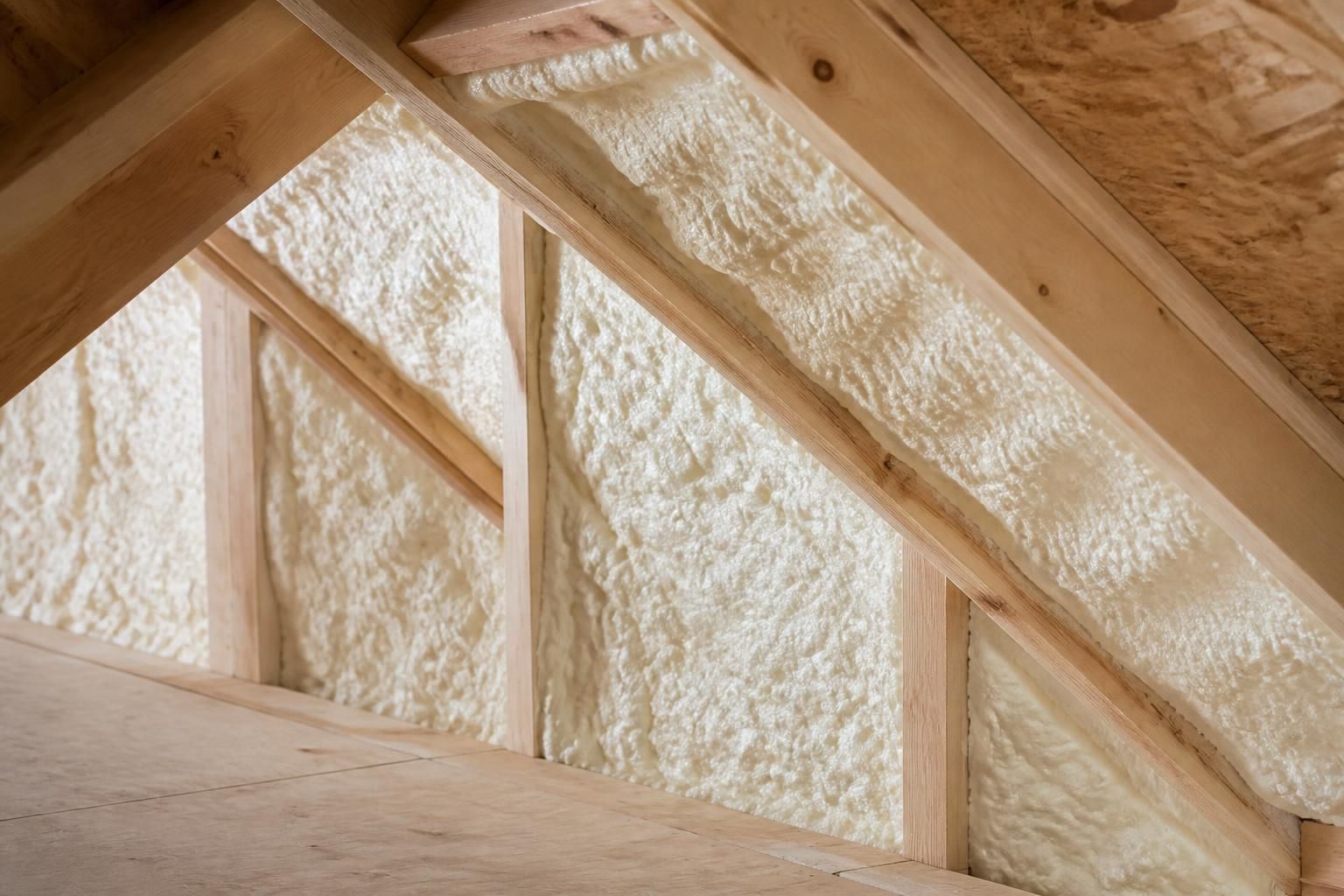
Rooms that warm up too fast, air conditioners that run longer than they should, and roof areas that still feel hot after sunset all point to a building envelope that is letting too much heat through. Spray foam insulation creates a seamless layer that helps slow heat transfer, seal small gaps, and reduce the strain on your cooling system.
For property owners across Grand Bahama, Island Spray Professionals Limited applies spray polyurethane foam with a focus on long-term value, not short-term patchwork. If you are planning an insulation upgrade for an attic, roof, walls, or subfloor, we can assess the surface, explain the right foam type, and recommend a practical path that fits the building and its use.
Spray foam begins as a liquid and expands on contact, building a continuous layer that follows the shape of the surface beneath it. That expansion is what makes it useful where batt insulation or loose fill can leave gaps, compress, or shift over time.
Once cured, the foam helps reduce unwanted air movement and heat transfer. In a climate where cooling demand matters, that can make a noticeable difference to comfort and energy use. It also helps create a tighter building envelope, which is valuable where roofs, attic spaces, and wall cavities need both insulation and air sealing support.
Closed-cell spray foam is dense, rigid, and highly suitable for insulation projects that need strong thermal performance and added resistance to moisture movement. It is commonly used for roof areas, ceilings, walls, and subfloors where a firmer material is preferred.
For roof systems, high-density foam is selected for its durability and ability to create a seamless protective layer. It can be applied to new or existing roofs, flat or sloped, where the goal is to reduce heat gain while strengthening the roof surface.
Spray foam is versatile, but the right application depends on the surface and the purpose. Some areas need thermal control first. Others need air sealing, moisture resistance, or a combination of both.
Island Spray Professionals Limited also handles specialty applications, so if your project is not a standard attic or roof scenario, we can still review the surface and determine whether spray foam is a sensible fit.
Grand Bahama properties often lose comfort through the roof first. When the roof area absorbs heat, it can radiate that heat back into the building long after the sun is lower. Spray foam helps slow that transfer, which can make indoor spaces easier to maintain at a steady temperature.
That matters for both homes and working buildings. Lower heat gain can reduce the load on cooling systems, improve room consistency, and limit the feeling of hot spots near upper levels or roof lines. In practical terms, it is about making the building easier to live and work in without asking the cooling equipment to do all the work.
The Bahamian climate makes roof insulation a daily performance issue, not an abstract upgrade. When heat enters the building too easily, cooling systems stay on longer and indoor comfort becomes harder to manage. Spray foam addresses the problem at the surface where it starts.
Roof insulation is one of the most effective uses for spray foam because the roof often carries the largest heat load. A seamless foam layer can help reduce solar heat transfer, close small openings, and support a tighter roof assembly.
For many property owners, the roof is also where multiple goals meet: comfort, durability, and long-term value. Spray foam can be used on new roofs or over existing roofs where the condition and project design allow it. The result is a more unified roof surface with fewer seams than many conventional approaches.
Traditional insulation materials can leave joints, overlaps, and weak spots. Spray foam expands to reach irregular spaces and adheres to the surface, which helps it perform as a continuous barrier rather than a collection of separate pieces.
Good spray foam work depends on surface preparation, correct mixing, and controlled application. Island Spray Professionals Limited uses factory-trained technicians and specialized spray equipment to apply foam at the right thickness for the surface and the intended use.
This process is important because spray foam is not a material that should be treated casually. Results depend on how it is applied, how evenly it expands, and whether the layer matches the needs of the surface.
Some insulation problems are obvious. Others show up as discomfort or rising energy use before anyone notices the root cause. If any of these sound familiar, spray foam may be worth a closer look.
These signs do not always point to the same fix, but they do tell you the building envelope is not doing enough to support comfort and efficiency.
Every project begins with the same question: what does the building need from the insulation? A home, a workshop, or a roof surface may each need a different foam density, thickness, or finishing approach. That is why a one-size answer is rarely the right answer.
Island Spray Professionals Limited serves Grand Bahama from Shelly & Milton Street, Freeport. We work with property owners who want a practical insulation solution that supports comfort, heat reduction, and long-term value. Whether the goal is a cooler attic, a tighter roof assembly, or insulation for walls and subfloors, the system should be matched to the structure rather than forced onto it.
Most requests are about lowering heat gain, making rooms easier to cool, and improving the performance of roof and attic areas. Some projects are part of a larger upgrade, while others focus on one problem space that keeps affecting daily comfort.
Some spray foam projects benefit from a protective or reflective coating. Elastomeric roof coatings can be applied over SPF or existing built-up roofs to help add surface protection and improve reflectivity. The right finish depends on the roof condition, desired performance, and project goals.
We can also discuss thermal barrier coatings where a project needs an added protective layer. That kind of planning matters because spray foam systems work as assemblies, not as isolated materials. Each layer should support the next one.
Yes. It can be used on roofs, attics, ceilings, walls, and subfloors, depending on the structure and the insulation goal.
Yes. It is widely used because it helps reduce heat transfer and limits air movement through the building envelope.
No. Spray foam can be applied to new or existing surfaces when the project conditions are suitable.
Roof applications benefit from its seamless coverage, thermal performance, and ability to conform to irregular surfaces.
It supports cooler interiors, reduces strain on cooling systems, and offers a durable insulation approach suited to local conditions.
Yes. It can be paired with coatings or used as part of a roof system designed to improve performance over time.
If your roof or attic is holding too much heat, or if you want a cleaner insulation solution for a wall, ceiling, or subfloor, Island Spray Professionals Limited can help you compare options and move forward with confidence. Call +12427270047 to discuss spray foam insulation for your Grand Bahama property.

Start Your Project
Share a few details about your roof, insulation needs, or coating project, and we will help you choose a practical solution for your property.